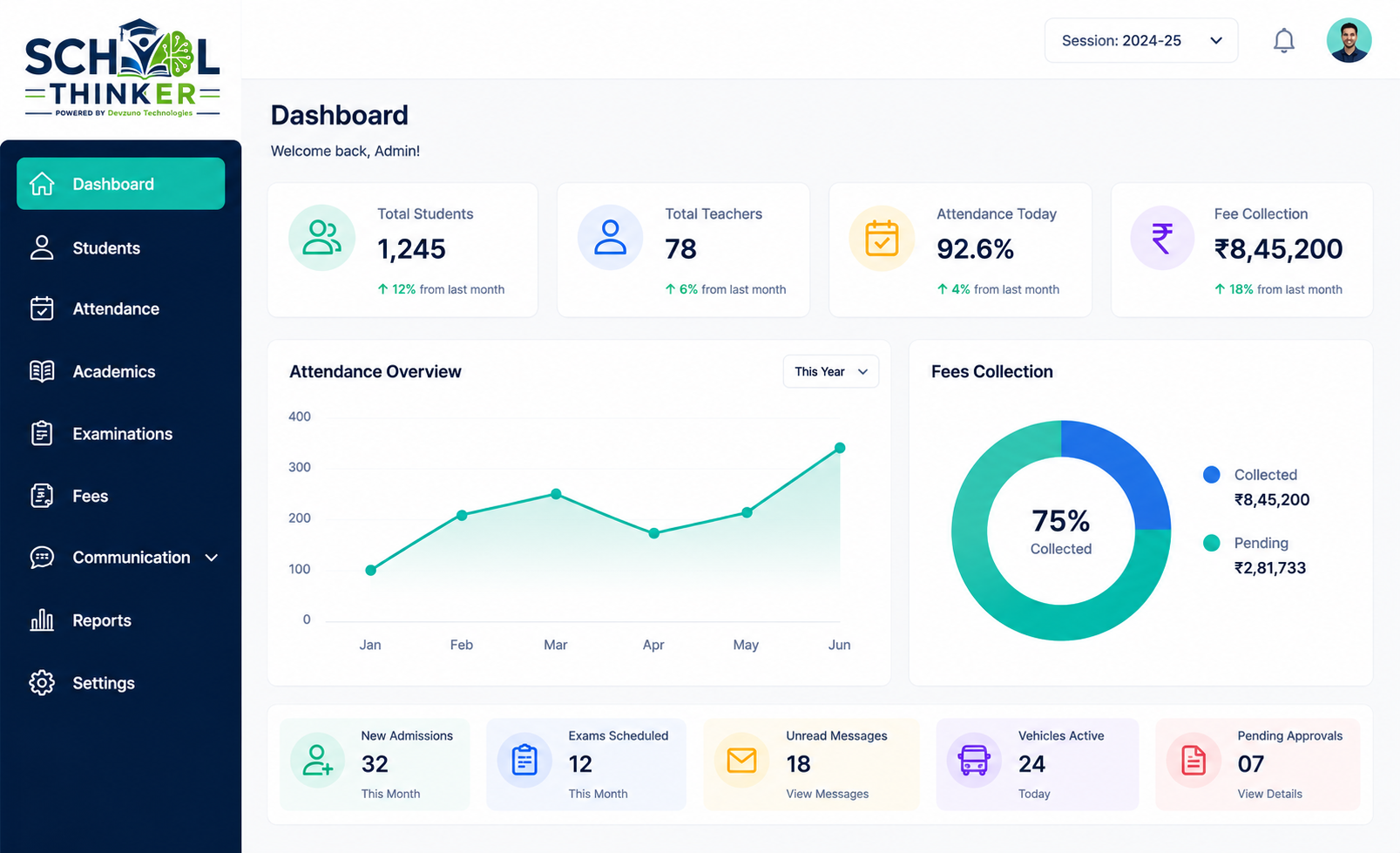
The Ultimate Guide to Choosing the Best School ERP Software in 2024
In the rapidly evolving landscape of education technology, managing a school efficiently requires more than just dedicated staff—it demands smart, integrated digital solutions. A School ERP Software (Enterprise Resource Planning) is no longer a luxury for large institutions; it has become a fundamental necessity for schools of all sizes, from preschools to massive K-12 networks and universities.
As educational institutions face mounting administrative burdens, regulatory compliance requirements, and the need for seamless parent-teacher communication, traditional paper-based methods and isolated spreadsheets simply cannot keep up. This comprehensive guide will explore everything you need to know about School ERP systems, why your institution needs one, and how School Thinker provides the ultimate AI-powered solution for modern school administration.
What Exactly is a School ERP System?
A School ERP system is a comprehensive, centralized software platform designed to digitize, automate, and manage the complete day-to-day academic and administrative operations of an educational institution. Imagine it as the digital nervous system of your school. Instead of using separate software for accounting, attendance, exam grading, and mass SMS communication, an ERP integrates all these functions into a single, unified dashboard.
This means that when a student pays their fee, the finance module updates automatically, a receipt is generated, the parents receive an instant SMS notification, and the school principal's revenue dashboard reflects the transaction in real-time. This level of synchronization eliminates data redundancy, reduces human error, and saves thousands of man-hours every academic year.
Top 10 Essential Features of Modern School ERP Software
When evaluating a School Management System, you must look beyond basic data entry. Modern ERPs are powered by automation and AI. Here are the most critical features that define a top-tier School ERP in today's digital era:
- 1. Centralized Student Information System (SIS): A complete digital repository of student profiles, including admission history, medical records, academic performance, and disciplinary logs, accessible instantly by authorized personnel.
- 2. Automated Fee Management & Collection: The financial backbone of any school. A great ERP automates fee structures, handles diverse payment modes (cash, UPI, bank transfers), generates instant digital receipts, and automatically sends overdue reminders to parents without manual intervention.
- 3. Smart Attendance Tracking: Moving away from paper registers, modern ERPs allow teachers to mark attendance via mobile apps in seconds, automatically calculating daily absentee percentages and instantly notifying parents if their child is absent.
- 4. Comprehensive Examination & Result System: The most time-consuming task for teachers is creating report cards. An ERP automates grading according to complex board guidelines (CBSE, ICSE, State Boards), generating beautiful, accurate report cards in a single click.
- 5. Dynamic Timetable Generation: Eliminating timetable clashes is historically a logistical nightmare. AI-powered ERPs automatically generate optimal schedules considering teacher availability, subject weightage, and classroom limitations.
- 6. Real-Time Parent Communication: Built-in messaging systems (App Push Notifications, SMS, and Email) bridge the communication gap between school and home, allowing instant sharing of notices, homework, and circulars.
- 7. Staff & Payroll Management: A dedicated HR module to track staff attendance, manage leave requests, calculate complex salaries (including taxes and deductions), and generate payslips automatically.
- 8. Transport & Fleet Management: Real-time tracking of school buses, route optimization, transport fee collection, and automated alerts for parents when the bus is approaching their stop.
- 9. Library & Inventory Management: Complete digital cataloging of library books, automated issuing/returning processes, late fee calculation, alongside tracking school assets and inventory items like uniforms and stationery.
- 10. Multi-Branch Dashboard: For trusts running multiple schools, a centralized dashboard providing macro-level analytics (total revenue, total strength) and micro-level control across all branches from a single admin login.
How Does a School ERP Software Save Time and Money?
Implementing a cloud-based School ERP is an investment that yields immediate and measurable returns. While the initial goal is often administrative organization, the long-term benefits directly impact the school's bottom line.
1. Eliminating Paper and Printing Costs
Schools consume enormous amounts of paper for admission forms, fee receipts, report cards, circulars, and attendance registers. By digitizing these processes, an ERP drastically cuts down on stationary, printing, and physical storage costs. Digital receipts and e-report cards are not only eco-friendly but entirely eliminate recurring printing expenses.
2. Automating Fee Follow-ups
Delayed fee collection is a massive pain point for school administrators. Manual follow-ups are awkward, time-consuming, and prone to oversight. An ERP automatically tracks payment deadlines and dispatches automated SMS and push notification reminders. This structured approach significantly improves cash flow and reduces bad debts without requiring staff to make hundreds of phone calls.
3. Drastic Reduction in Administrative Workload
Tasks that previously took weeks—like compiling term-end report cards or manually calculating staff salaries—can now be executed in minutes. This massive reduction in clerical work allows schools to operate efficiently without needing to constantly expand their administrative staff as student enrollment grows.
4. Empowering Teachers to Focus on Teaching
When teachers spend less time marking attendance, writing diaries, manually calculating grades, and drafting notices, they can dedicate more time to actual curriculum planning and student engagement. An ERP directly contributes to improved academic outcomes by freeing up your educators' most valuable resource: their time.
The Challenge of Legacy Systems vs. Cloud-Based ERPs
Historically, schools relied on desktop-based, offline software installations. These legacy systems are fraught with critical vulnerabilities. They are tied to a single physical computer, highly susceptible to hard drive crashes (resulting in total data loss), and impossible to access remotely. Furthermore, they lack the ability to provide real-time updates to a parent mobile app.
A modern Cloud-Based School ERP Software like School Thinker operates entirely on secure internet servers (like AWS). This offers transformative advantages:
- Zero Hardware Investment: No need for expensive local servers or specialized IT staff. You only need a web browser and an internet connection.
- 100% Data Security: Automated daily backups ensure your critical data is never lost to hardware failure or localized disasters.
- Work from Anywhere: Administrators can check fee collections from home, and teachers can upload marks or mark attendance via their smartphones.
- Seamless Updates: Software updates and new features are pushed to the cloud instantly without the need for manual installations or disruptive downtime.
Why School Thinker is the Best School ERP Software in India
While the market is flooded with generic management tools, School Thinker was built from the ground up with a deep understanding of the unique challenges faced by Indian educational institutions. Here is why thousands of progressive schools choose School Thinker as their technology partner:
Unmatched User Experience and Simplicity
The biggest hurdle in adopting new technology in schools is the learning curve for non-technical staff. School Thinker boasts a remarkably intuitive, mobile-responsive interface. Whether it's a veteran accountant generating fee reports or a new teacher taking attendance, the system is designed to be self-explanatory, requiring minimal training.
Artificial Intelligence & Smart Automation
School Thinker goes beyond basic data storage by incorporating AI elements to handle complex logic. From our conflict-free AI timetable generator that saves weeks of planning, to predictive analytics that highlight students at risk of dropping out based on attendance and grade trends, School Thinker turns your raw data into actionable insights.
Incredible Value and Transparent Pricing
We believe world-class technology should be accessible to schools of all sizes. Unlike competitors that charge massive setup fees and complicated module-based pricing, School Thinker offers simple, per-student monthly pricing that includes all premium modules. This democratization of technology ensures even budget-conscious schools can operate like elite institutions.
Robust Dedicated Support
Software is only as good as the support behind it. Transitioning to a digital system can be daunting. Our dedicated customer success team provides hands-on onboarding, data migration assistance, and lightning-fast priority support to ensure your school's operations run flawlessly 24/7/365.
Steps to Successfully Implement an ERP in Your School
Transitioning from manual registers to a digital platform requires a structured approach to ensure high adoption rates among staff and parents.
- Identify Your Core Needs: Analyze your most critical pain points. Is it fee collection? Exam grading? Parent communication? Ensure the ERP you choose directly addresses these primary issues.
- Data Standardization & Migration: Before importing data into the new software, clean up your existing records in Excel. Standardizing names, classes, and fee balances ensures a smooth digital transition. Our team handles this heavy lifting for you.
- Comprehensive Staff Training: Conduct focused training sessions. Train the finance team on fee modules, and teachers on attendance and exam modules. A phased rollout prevents overwhelming the staff.
- Parent Onboarding: Educate parents on how to download the mobile app, view reports, and receive notices. The true power of an ERP is realized when parents actively engage with the digital ecosystem.
The Future of Educational Administration
As we look toward the future, the integration of Artificial Intelligence and Machine Learning in School ERP systems will only deepen. We are moving toward predictive models where the software can identify learning gaps in students before exams, or predict seasonal cash flow shortages for administrators.
Embracing a School Management System is no longer about staying ahead of the curve; it is about keeping up with the baseline expectations of digital-native parents and modern educational standards. By choosing a forward-thinking platform like School Thinker, you are future-proofing your institution against the administrative challenges of tomorrow.
Ready to transform your school's administration? Start your 15-Day Free Trial with School Thinker today and experience the power of the ultimate School ERP software.